How a Brain Module Functions
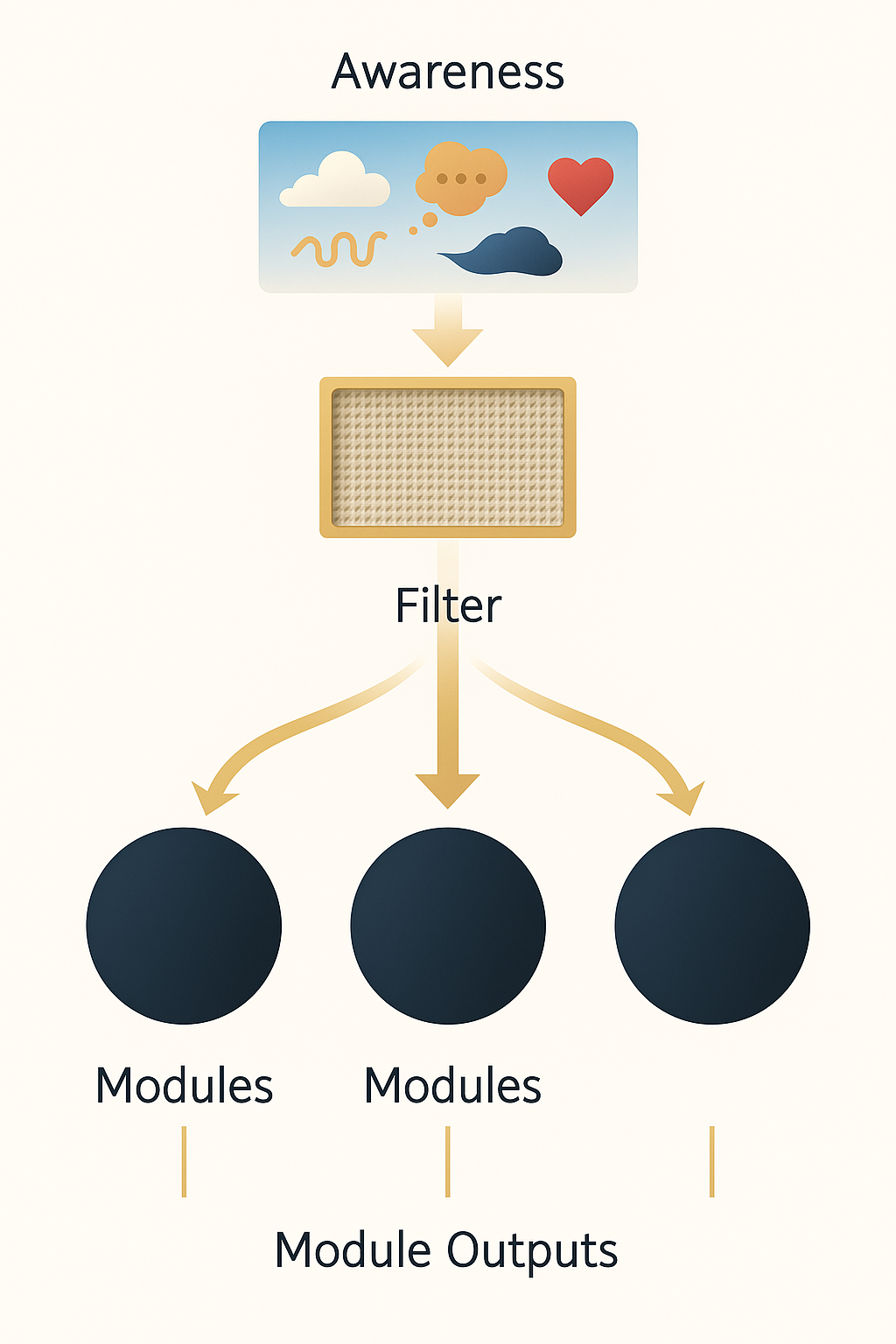
Phenomena rise and dissolve within the field of awareness moment by moment: thoughts, emotions, sensations, memories, dreams, visions, perceptions. Anything that crosses the threshold of consciousness qualifies. And once they appear, they do not remain inert. They are immediately drawn into the mind’s subtle filtration processes. Depending on the particular contour of the phenomenon, its emotional gravity, its sensory texture, or its cognitive shape, it moves along a specific neural route, guided with quiet precision toward a processing module deep within the brain.
Each module has its own way of working, an inner logic that meets the incoming phenomenon and transforms it. When the module finishes its task, it releases a product, sometimes one, sometimes several. Some sink quietly into the unconscious, disappearing as though into deep water. Others rise again as fresh phenomena, returning to awareness with a new face. At times the outgoing product resembles the original, only softened, sharpened, or clarified. At other times it emerges entirely changed. But whatever form it takes, it is drawn back into the flow, filtered again, and directed to the next module. This cyclical motion unfolds at a speed the conscious mind cannot follow, giving rise to what we call understanding, interpretation, or reaction. It also creates the conditions in which a single experience can be magnified into joy or into suffering.
Consider a simple example: the scent of food cooking nearby. The first phenomenon is the sensory impression itself, perhaps accompanied by a light stir of emotion or an idle thought. That scent passes through the filter, enters its module, and returns transformed: a quiet thought of “Those French fries smell wonderful,” or the subtle ache of hunger. A single module can generate a constellation of such products: a craving, a memory, an imagined image of the food, a feeling from childhood associated with the same smell. Each of these reenters awareness, is filtered again, and continues on its circuit.
This is harmless enough when the phenomenon is only the smell of fries. But imagine a different circumstance. Imagine that the same smell was present on the day your village was attacked, the day your family was killed. The identical scent would then carry a very different significance. The module that receives it would no longer be neutral. It would be saturated with terror and grief. Its algorithm would have been rewritten. The products it now releases, fear, intrusive images, physical shock, no longer resemble hunger. They are the echoes of trauma.
Trauma begins in this way. It is not the original phenomenon that wounds, but the way the mind has learned to process it. For one person, the smell may evoke nothing more than a memory. For another, it may summon despair, panic, dissociation, or the impulse to die. When every encounter with the same stimulus triggers collapse, loss of appetite, or emotional storms, the module responsible has become misaligned.
And when a module becomes misaligned, the task is not to eliminate the phenomenon but to repair the mechanism that interprets it, to reshape, revise, or reconfigure the module itself. The stimulus was never the danger. The processing became the danger. To recognize this is to understand the nature of trauma and perhaps the beginning of its transformation.
Yet these are not the only modules that can be shifted or renewed. The sense of who we are, the personality we take to be solid, is shaped to a great extent by the particular collection of modules that operate within us. A tendency toward laziness or toward effort, a habit of procrastination or a preference for finishing tasks early, these are not fixed traits in any ultimate sense. They are patterns produced by specific modules. With the right methods, these patterns can be revised. In some cases the modules themselves can be updated, reshaped, or even replaced. What appears to be character may simply be the residue of old processing that has never been questioned. And what appears to be fate may turn out to be a system that can be changed.